Herbal medicine for women’s health
Using herbal medicine for women\u2019s health concerns and management often form a large part of a naturopath\u2019s repertoire.
These herbs are always tailored to the individual and what is going on for them.
There are similar yet subtle differences to the herbs we use, and it takes a trained herbalist to be attuned to these differences and be able to select the appropriate herbs.
Here are some of the most commonly used herbal medicine for women\u2019s health.
Vitex
Common name: Also known as chaste tree
Botanical name: Vitex angus-castus
You can think of vitex for pretty much any complaint that is worse before menstruation or in the luteal phase \u2013 including premenstrual syndrome (PMS), acne that is worse before a period, spotting, bloating and tender breasts.
Caution: vitex as amazing for many things, BUT, if you have PCOS, vitex may not be the right herb for you. This is because it can raise luteinising hormone (LH) levels which in many women with PCOS is already too high, thus it can worsen cycle regularity if this is the case for you.
Paeonia
Botanical name: Paeonia lactiflora
This herb is one the most versatile herbal medicines for women\u2019s health. It is also a regulatory of the HPO axis as it helps to regulate menstrual irregularities. As a spasmolytic it is great to add into a herbal for spasmodic dysmenorrhea.
Dong Quai
Botanical name: Angelica sinensis
It is a warming herb that improves blood flow to the uterus.
Shatavari
Botanical name: Asparagus racemosus
\u201cShatavari\u201d means a woman with one thousand husbands and is traditionally an Ayurvedic herbal medicine. It is a versatile herb used for tonifying and nourishing female reproductive functions. It increases libido (hence the name\u2019s meaning), is a tonic to the ovaries, enhances folliculogenesis and ovulation, supports healthy mucus production, can help prevent miscarriages and can also be used post-partum to support healthy lactation. An added benefit is that it is also an adaptogen, which means it aids the body\u2019s resilience to stressors. It can be used in young women with menstrual issues, right up to post-menopausal women.
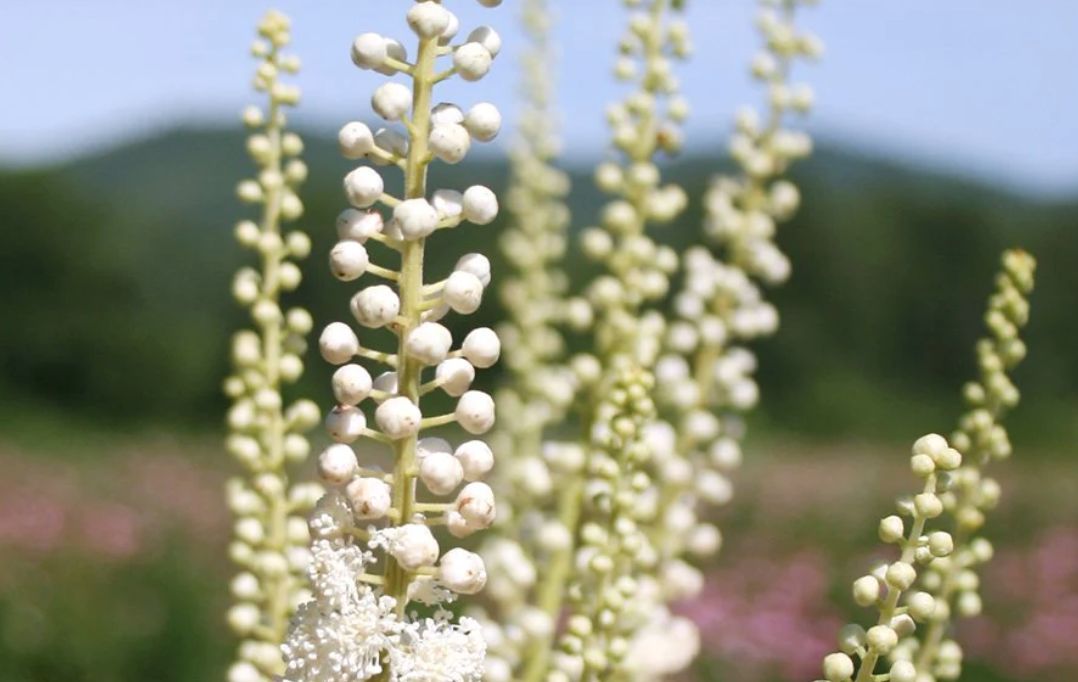
Black Cohosh
Botanical name: Cimicifuga racemosa
This herb is primarily used in menopausal women for menopausal symptoms. This is largely due to its oestrogen modulating effects. It is also thought to have its effects due to its effect on regulating serotonin in the body, which is involved in mood regulation and temperature regulation in the body. It can be used alongside or when weaning off Hormone Replacement Therapy (HRT), under direction of a qualified herbalist.
It can also be considered for PCOS and other cycle irregularities in younger women, not just exclusively for pre or post-menopausal women.
False Unicorn Root
Botanical name: Chamaelirium luteum
This beautiful herb unfortunately is endangered and so its use can be controversial and should be limited.
Ladies Mantle
Botanical name: Alchemilla vulgaris
This makes it a great herb for both young women and perimenopausal with heavy bleeding. Of course, in these cases, underlying issues should first be investigated as to why the bleeding is heavy or abnormal in the first place.
A woman can be experiencing an issue for months or years and, once starting their herbs, they can see amazing changes either immediately or progressively cycle by cycle.
References
Trickey, R. (2011). Women, Hormones & The Menstrual Cycle (3rd ed.). Fairfield: Trickey Enterprises Pty Limited.
Bone, K. (2007). The Ultimate Herbal Compendium. Warick: Phytotherapy Press.
Disclaimer: I\u2019m not a doctor. All information is intended for your general knowledge only and is not a substitute for medical advice or treatment for specific medical conditions. You are responsible for your own health and for the use of any remedies, treatments, or medications you use at home. Herbs are powerful medicine. You should always speak to your health provider before ingesting any herb, especially if you are pregnant, breast-feeding, or on any other medications.
Đăng ký bản tin của chúng tôi
Bạn thích bài viết này? Tham gia The WomenLoveHerbs Weekly — một loại thảo dược, một nghi thức, một góc nhìn mới mỗi thứ Ba, miễn phí.