Yin & Yang in a Woman's Day
Up at dawn, inbox by seven, meetings till five, family till ten — and then, somehow, wide awake at midnight. TCM has a two-word description of that day. This lesson teaches you to see it.
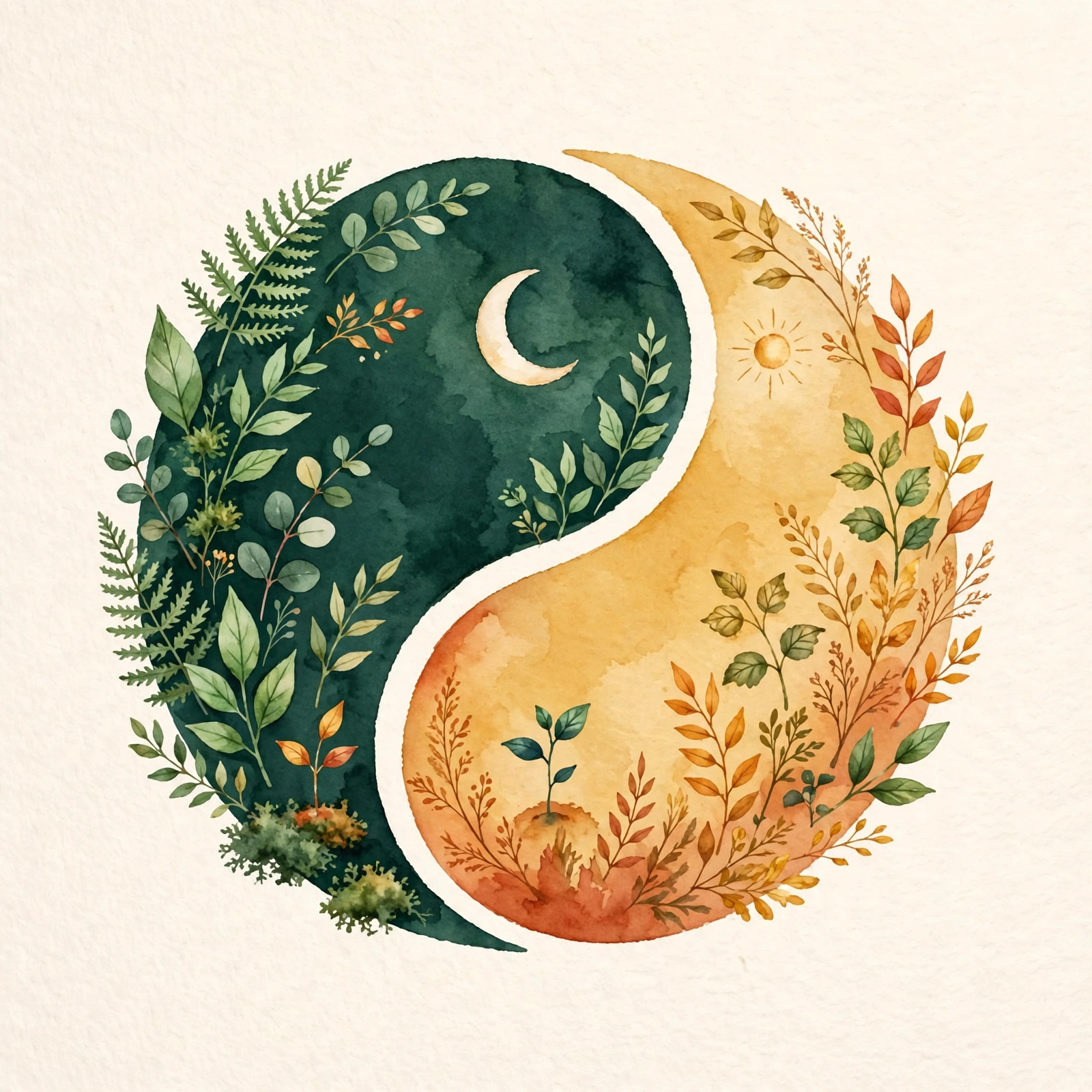
The original idea. Yin and yang are TCM's oldest pair of lenses: two complementary tendencies in everything. Yang is activity, warmth, light, movement, the outward and the day. Yin is rest, coolness, moisture, stillness, the inward and the night. Neither is "good" or "bad" — the famous symbol shows each carrying a seed of the other, because in a living system they constantly turn into each other.
Your day, translated. A yang morning (rising, moving, working, deciding) spends the day's energy; a yin evening (dimming, cooling, quieting) rebuilds it. Sleep, in this model, is yang retreating into yin to be restored. Digestion has the same rhythm: warm, active transformation by day; rest by night.
Imbalance, in TCM language. Two classic pictures: too little yin — the system runs hot and dry: restless evenings, night-time waking, a feeling of being "tired but wired." Too little yang — the system runs cold and slow: heavy mornings, cold hands, low drive, everything feeling like effort. These are pattern descriptions in a traditional system — a language for noticing, not diagnoses.
The evidence lens, honestly. Modern physiology has its own version of this rhythm — circadian cycles, cortisol curves, core temperature rising and falling. The maps are not the same map, and this course never fuses them; but the shared practical wisdom is real: humans do better when activity and rest alternate on purpose.
Why this matters to you. Every later lesson hangs on this pair. Herbs and foods in TCM are classified by whether they warm or cool, raise or settle, build yin or support yang. Learn to see your own day in yin-yang terms and the whole system starts making sense.
🛡️ Safety first
Yin-yang language describes patterns, never diseases. Persistent insomnia, exhaustion, or feeling cold all the time deserve a clinician's workup (thyroid and anaemia are on that real-world list) — TCM vocabulary is for learning, not for ruling anything out.
🎯 Try it
Tonight, draw your day as a simple curve: when were you most "yang" (active, bright, warm) and when most "yin" (resting, cooling, quiet)? Mark the moment the turn should have happened. That single observation is the seed of yang sheng — the art of nourishing life (Track 6).
✏️ Quick quiz
WomenLoveHerbs is education only. Nothing here diagnoses, treats, or cures any condition, or replaces your healthcare professional.